




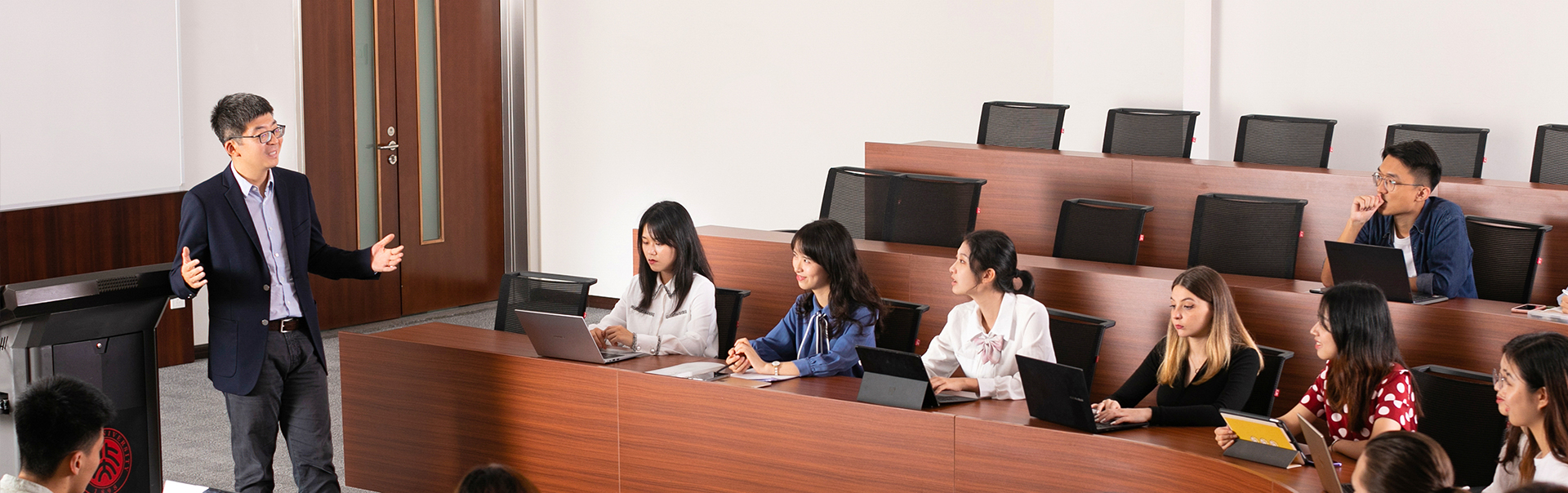


学术讲座 seminar
-
Should Referral Programs Reward Customers for the Short-Term Performance of T...
Yupeng Chen, Nanyang Technological University
Wednesday, April 8, 2026 | 2:00pm-3:30pm | Room 333 ||
Abstract:Referral programs are widely used by firms as a tool for new customer acquisition. In practice, most referral programs reward existing customers for the acquisition of their referrals (i.e., referred customers). Although such acquisition-based referral rewards incentivize existing customers to refer new customers, they can be ineffective in generating high-value referrals. To increase the value created ...
-
Consumer Demand with Price Aggregators and Low-Rank Cross-Price Effects
Thibault Fally, University of California, Berkeley
Wednesday, April 8, 2026 | 2:00pm-3:30pm | Room 337 ||
Abstract:Estimating consumer demands is a bread-and-butter undertaking in applied economics. In general, demand for each good depends on the prices of all goods and services, but for most applications it is impractical to estimate models of such high dimension. In this paper, we consider consumer demand with a low rank of the matrix of cross-price effects, a property implicitly assumed in most empirical settings....
-
Set it and Forget it: Engineering Investment Habits with FinTech
Alberto Rossi, Georgetown University
Tuesday, April 7, 2026 | 3:30pm-5:30pm | Room 339 ||
Abstract:We study how automated investment rules affect saving behavior and investment outcomes using detailed data from a FinTech app designed to help retail investors access mutual funds. Users choose how to design these rules, which vary along dimensions such as frequency, amount, and triggering conditions. Using a randomized encouragement design, we show that automated rules causally increase average savings ...
-
Data as a Networked Asset
Bo Bian, The University of British Columbia
Wednesday, April 1, 2026 | 2:00pm-3:30pm | Room 339 ||
Abstract:Data is non-rival: a firm's customer data informs other firms about their customers. We uncover a network of inter-firm data conduits embedded in mobile applications. Data sharing induces comovement in firms' operational, financial, and stock-market performances, propagates shocks (e.g., cyberattacks), and induces herding in product design. Apple's privacy policy---a shock to inter-firm data flows-...
-
Firm Expectations, Innovation and Growth
Leo Kaas, European University Institute
Thursday, March 26, 2026 | 10:30am-12:00pm | Room 421 ||
Abstract:Using a large and representative panel survey of German firms, we document sizable forecast errors in employment growth which decline with firm age and which are related to R&D investment and innovation. Motivated by this evidence, we build an endogenous growth model with heterogeneous firms which learn their productivity from noisy signals, decide about innovation activity, employment, and exit. Aggregate ...
-
When Is Less Better Than More? Reductions in Firm Scale and Scope During Econ...
Jay Anand, Ohio State University
Wednesday, March 18, 2026 | 10:00am-11:30am | Room 335 ||
Abstract:Past research has paid little attention to why and how firms choose to reduce their size. Size reductions can come about either by a reduction in the scale of operations or a reduction in the scope of activities undertaken by the firm. We argue and show that firms are more likely to reduce the scale of their operations but less likely to reduce the scope of their activities in the event of an economic ...
-
Monetary Policy Without Borrowing: Capacity Constraints and Lumpy Investment
Felipe Saffie, University of Virginia
Wednesday, March 18, 2026 | 9:00am-10:30am | Room 337 ||
Abstract:Understanding monetary transmission requires understanding which firms respond to interest-rate changes. We study how limited access to debt shapes firm-level transmission of monetary policy. Using monthly administrative records for all Chilean firms that file VAT returns, matched to a comprehensive credit registry, we combine firm outcomes with monetary policy surprises. We document substantial pass-...
-
Going Digital and Onchain: Tokenization, Ecosystem Development, and Wealth Dy...
Will Cong, Nanyang Technological University
Wednesday, March 18, 2026 | 2:00pm-4:00pm | Room 339 ||
Abstract:I start by discussing the facts and implications about distributed ledgers, stablecoins, real-world-asset tokenization, foundations of tokenomics, before delving into a theoretical framework for investigating the impact of digital platforms and crypto-tokens on the development and wealth inequality of a modern economy. Specifically, we build a continuous- time model of user heterogeneity, platform ...
-
Making Sovereign Debt Safe and Sustainable
Ramon Marimon, European University Institute
Monday, March 16, 2026 | 2:00pm-3:30pm | Room 337 ||
Abstract:An overview of part of my reseach agenda On the Design of a Financial Stability Fund. Starting from the fundamental design of a Fund that can absorb the Soverign Defaultable Debt of a country and transform it in a long-term state-contingent safe asset, making the debt sustainable (defaultfree) and providing risk-sharing and smooth consumption to the country, while preventing the Fund from having expected ...
-
Working With, Through, and Against AI in Communication Research
Jörg Matthes, University of Vienna, Austria
Wednesday, March 11, 2026 | 2:00pm-3:30pm | Room 333 ||
Abstract:Artificial intelligence is rapidly transforming the world, including the ways we do research. This talk examines how generative and analytical AI systems are reshaping the entire research process in communication science (and beyond), from literature review and hypothesis generation to research design, data collection, analysis, writing, and peer review. Using concrete examples from automated content ...